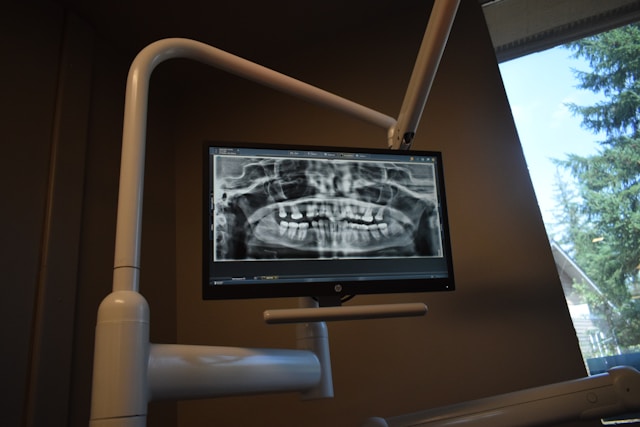
Dental X-rays are very low-dose imaging tests that help dentists find problems that are not visible during a routine examination, such as decay between teeth, infections, bone loss, and problems under fillings or crowns. 1 12 15 The American Dental Association says X-rays should be taken only when clinically justified, meaning when the expected diagnostic benefit outweighs the small radiation risk. 1 15
In simple terms, dental X-rays are not considered harmful when used appropriately. 2 1 15 Like all medical imaging that uses ionizing radiation, they should not be taken unnecessarily, but modern dental X-rays use very small doses and are designed to limit exposure. 1 11 15
How much radiation do two small dental X-rays give?
For bitewing X-rays, the radiation dose is tiny. One source summarizing dental X-ray doses reports about 0.3 to 5 microsieverts (µSv) for a single digital bitewing, while the American Association of Orthodontists says dental X-rays commonly fall around 1 to 8 µSv depending on the type of image. 7 9
If a patient has two small bitewing X-rays every two years, the dose is still extremely low and is often comparable to only a small amount of natural background radiation. 7 9 1 To put that in plain language, the exposure is so small that many dental organizations describe it as being in the range of normal everyday background exposure, not a meaningful stand-alone health risk. 7 1
A simple comparison in everyday terms
A useful way to think about it is this: the radiation from dental X-rays is much lower than many people imagine and is often compared with routine background exposure from the environment. 7 9 1 Exact comparisons vary by the type of X-ray and the source used, but the overall message from dental associations is consistent: the dose is very small and should be ordered only when it adds diagnostic value. 1 15
Why X-rays matter
The main benefit of dental X-rays is that they can detect problems before they become painful or expensive to treat. 1 12 This is especially important for interdental decay — decay that starts between teeth, where a dentist may not see it with the naked eye during a visual exam. 8 1
Without X-rays, early cavities can be missed until they grow larger, damage more tooth structure, or reach the nerve of the tooth. 8 1 15 In that sense, the benefit of X-rays is often preventive: they help dentists treat a small problem early instead of waiting until it becomes a bigger one. 1 12
What do dental and radiology groups say about safety?
The American Dental Association says dental X-rays should be used with professional judgment and only when they are likely to provide information that helps patient care. 1 15 The ADA’s updated recommendations also state that protective aprons and thyroid collars are not routinely necessary for patients during dental radiography, because the radiation dose is already very low and shielding does not add meaningful benefit in routine cases. 2 11 15
The American Academy of Oral and Maxillofacial Radiology, as cited by Tufts, also supports the view that modern dental X-rays use very little scatter radiation and that routine lead aprons and thyroid shields do not provide additional benefit in most cases. 11 The AAPD radiation-safety guidance emphasizes dose reduction techniques such as proper beam collimation and appropriate operator positioning, which reflect the broader approach of minimizing exposure while preserving diagnostic quality. 4
Is it better to skip X-rays?
Not usually. Skipping X-rays may reduce a tiny radiation exposure, but it can also mean missing hidden decay, infection, or bone loss that would otherwise be found early. 8 1 15 Dental organizations generally support taking X-rays at intervals based on a patient’s individual risk, rather than on a rigid timetable for everyone. 8 9 12 15
For adults with no active dental problems and low risk, guidance commonly supports X-rays every two to three years, while higher-risk patients may need them more often. 8 9 That means a schedule such as two small bitewing X-rays every two years is broadly consistent with risk-based care for many patients. 8 9
Bottom line
Dental X-rays are generally safe when used appropriately and the radiation dose from a small number of bitewing X-rays is very low. 2 7 1 15 For most patients, the diagnostic benefit — especially finding hidden decay between teeth early — outweighs the small potential risk of the radiation exposure. 1 12 15
If you are unsure whether X-rays are needed, the best approach is to discuss your individual cavity risk, symptoms, and dental history with your dentist. 1 15
Castle Hill Smiles
Tel: (02) 9899 8686
Email: castlehillsmiles@gmail.com
Web: www.castlehillsmiles.com.au