


Why See the Orthodontist by Age 7?
• The American Association of Orthodontists says the first check-up should happen no later than age 7.
• At this age the upper jaw (palate) is still “soft,” so gentle expanders can widen it easily—something that is much harder once the bones fuse in the teen years.
• Early care can open a child’s nasal passages, guide jaw growth, and often shorten or even eliminate the need for full braces later.
5 Parent-Friendly Benefits of Early Orthodontics
1. Easier Breathing and Better Sleep
– A narrow upper jaw leaves less room for the nose and throat.
– Simple devices like a Rapid Palatal Expander (RPE) can widen the airway by nearly 30 % (McNamara 2015).
– Studies show many kids who snore or have mild sleep apnea breathe much better after expansion (Pirelli 2019).
2. Healthier Jaw Growth
– Between ages 7–8 the upper and lower jaws surge in growth.
– Correcting cross-bites or large overjets early lets the jaws grow evenly, lowering the risk of TMJ pain down the road.
3. Fewer Years in Braces (or None at All)
– Research from UNC–Chapel Hill shows early-phase patients spend about 30 % less time in full braces as teens.
– Many avoid tooth extractions or jaw surgery altogether (Baccetti 2018).
4. Straighter Smiles During the Tween Years
– Expansion, space maintainers, or small braces on front teeth can align the most visible teeth before middle school photos start.
5. Lower Dental Costs Over Time
– Two short, targeted phases are often cheaper than one long, complicated round of fixed braces and possible surgery later.
Signs Your Child May Need Early Orthodontic Help
- Mouth breathing or nightly snoring
- Upper teeth sit inside lower teeth (cross-bite)
- Big overjet (“buck teeth”) greater than 6 mm
- Early loss of baby teeth with drifting or crowding
- Speech difficulties linked to tongue position
If you spot any of these, book an orthodontic evaluation—no referral needed.
What Does Early Treatment Look Like?
Step 1: Records Day
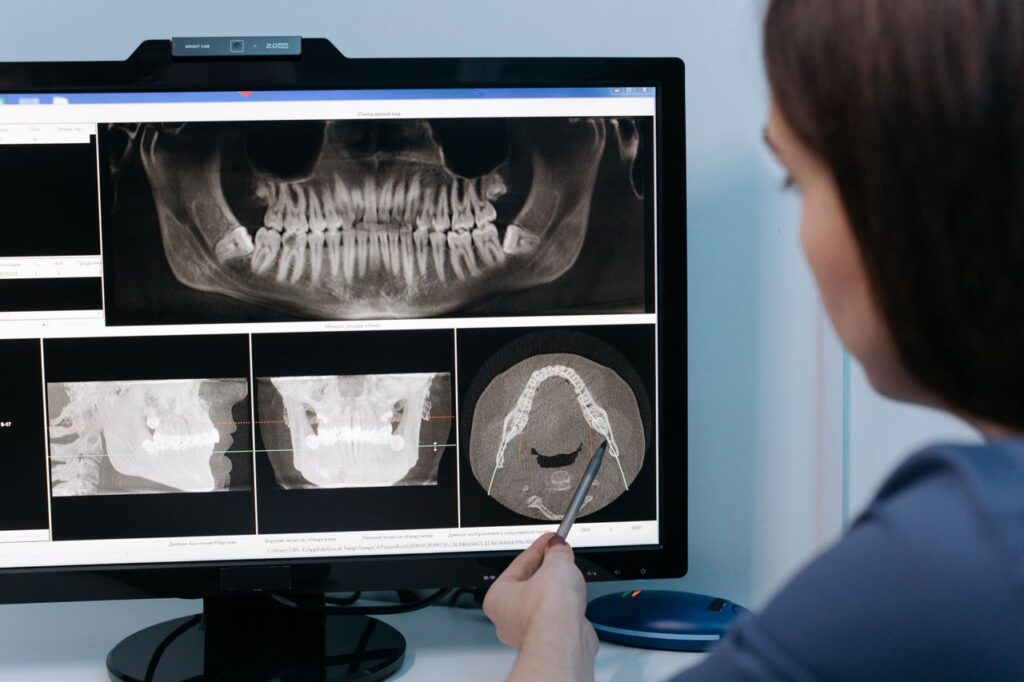
• Panoramic and side-view (ceph) X-rays, 3-D airway scan, and photos.
Step 2: Active Phase (6-12 months)
• Possible appliances: Rapid Palatal Expander, Twin-Block, or removable plates.
• Monthly check-ups take about 15 minutes.
Step 3: Retention Phase
• Child wears a small retainer at night while permanent teeth erupt.
• Growth is monitored every 6 months.
Step 4: Phase II (Only If Needed, Age 12+)
• Shorter, lighter braces or clear aligners fine-tune the bite.
Quick FAQ for Parents
Is my child too young for “braces”?
At 7 the goal is usually an expander or simple plates, not full metal braces.
Will it hurt?
Most kids say the pressure feels like a mild “tight hug” on the teeth for a day or two.
How much does early orthodontic treatment cost?
Fees vary, but many offices bundle Phase I and any future braces into one package. Ask about payment plans and insurance coverage.
What if I wait until the teen years?
Waiting often means longer treatment, higher costs, possible extractions, and a lost chance to improve airway growth during the easiest window.
Take-Home Message
Early orthodontic treatment—often starting around age 7—can:
• Help your child breathe and sleep better,
• Guide jaws to grow in the right direction, and
• Reduce or even skip long-term braces later.
Schedule that first orthodontic visit now — it’s a small step that can make a big difference in your child’s health and confidence.
Parent-Accessible Sources
- American Association of Orthodontists – “Why See an Orthodontist by Age 7?” (aaoinfo.org)
- McNamara J.A. et al. “Airway Changes After Rapid Palatal Expansion,” AJODO 2015.
- Pirelli P. & Saponara M. “Early Expansion Reduces Pediatric Sleep Apnea,” Eur Arch ORL 2019.
- Tulloch J.F. et al. “Timing of Early Orthodontic Treatment,” UNC/NIH Report 2008.
- Baccetti T., Franchi L., & McNamara J.A. “Efficiency of Two-Phase Treatment,” Seminars in Orthodontics 2018.
Castle Hill Smiles
Tel: (02) 9899 8686
Email: castlehillsmiles@gmail.com
Web: www.castlehillsmiles.com.au
